Process Engineering · Çanakkale, Türkiye
Pendulum Roller Mills, Dynamic Air Classification, and Plant Retrofit Engineering
Aksa Process Plant Teknik is a Turkish process-engineering company specialised in pendulum roller (Raymond-type) grinding mills, dynamic air classifiers, and the retrofit of underperforming grinding plants — from a single wear part to a complete micronized-mineral grinding system.

Engineering that starts from the plant problem
Industrial plants do not always need a completely new system. In many cases, they need disciplined engineering review to understand grinding performance, classifier cut behavior, wear mechanisms, maintenance limits, and operational reliability under the actual material and process conditions.
Our work combines machine know-how, retrofit thinking, and plant-oriented technical support with a strong foundation in grinding and classification systems.
Practical engineering for demanding industrial applications
Pendulum roller mills & dynamic air classification
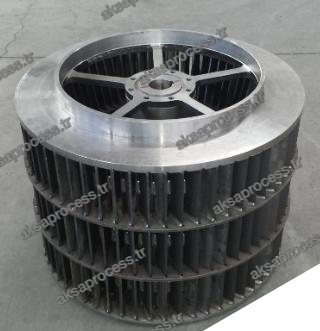
Our strongest technical differentiation: air-classifier cut and circulation behavior, vortex breaker wheel concepts, wear-sensitive components, mechanical sealing, and vibration-related mechanical review.
Separation depends on particle size, density, shape, airflow, classifier geometry, rotor speed, and feed conditions — not on size alone.
Pendulum roller mill installations
| Material | Customer / Site | Country | Machine |
|---|---|---|---|
| Magnesite | Ternamag, Evia Island | Greece | PM 20 |
| Magnesite | Darat Mining, Riyadh | Saudi Arabia | PM 13 |
| Magnesite | Magna Magnesit, Navarra | Spain | PM 14 |
| Kaolin | Maydan LLC, Polonsky | Ukraine | PM 16 |
| Calcite | Niğtaş Madencilik, Niğde | Türkiye | PM 13 |
| Barite | Barit Maden AŞ, Osmaniye | Türkiye | PM 16 |
| Petcoke | Türkmag, Aşkale / Erzurum | Türkiye | PM 16 |
| Porcelain scrap | Kütahya Porselen, Kütahya | Türkiye | PM 13 |
When existing systems need to perform better
Pendulum mills and air classification, briefly explained
What is a pendulum roller mill (Raymond mill)?
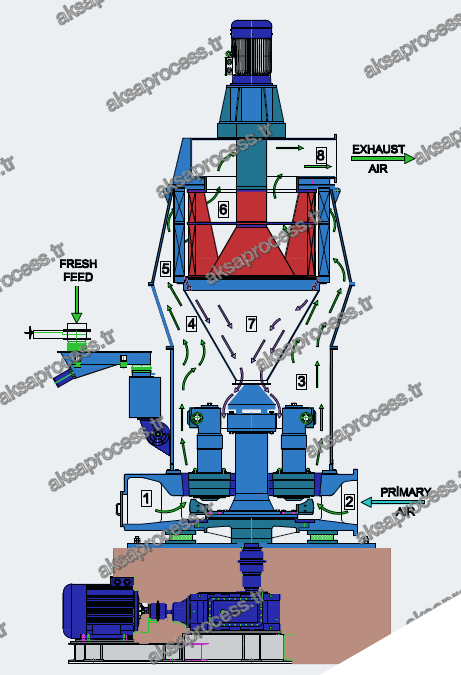
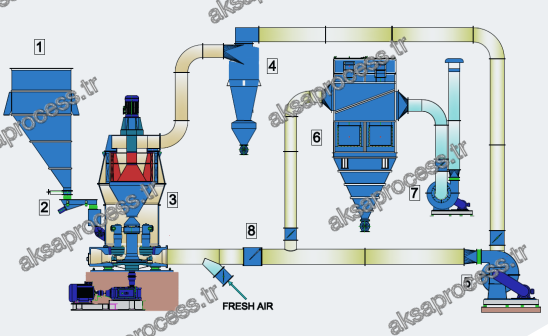
A pendulum roller mill — often called a Raymond mill — is an air-swept vertical mill in which grinding rollers swing on pendulums against a grinding ring. System air carries the ground material to an integrated dynamic classifier: oversize particles return to the grinding zone, and fines leave as product. Where process conditions allow, the same air stream can also dry the material. It is a standard machine for fine grinding of industrial minerals.
Which materials are pendulum mills used for?
Typical applications are industrial minerals such as calcite, magnesite, dolomite, barite, kaolin, feldspar, and quartz, as well as petcoke and porcelain scrap. Our own reference installations cover all of these. Achievable fineness and capacity depend on the material, the classifier, and the operating conditions, so they are assessed per application.
Can an underperforming or imported mill be upgraded instead of replaced?
Very often, yes. Common root causes — classifier inefficiency, dust ingress at the roller seals, joint vibration, worn components, or airflow problems — can be addressed with a retrofit: classifier or vortex-breaker-wheel upgrades, mechanical sealing, ultra-bushing conversion, and wear-part revision. We start with a technical review to confirm the root cause before proposing any modification.
Why does the air classifier matter so much for mill performance?
In an air-swept mill, grinding and classification share one air circuit. If the classifier cuts poorly, already-fine product is sent back for regrinding, the circulating load rises, and capacity and energy efficiency suffer. A sharper cut — the goal of the vortex breaker wheel concept — reduces coarse/fine remixing and wasted regrinding.
Where does Aksa Process work?
We are based in Çanakkale, Türkiye, with documented installations in Türkiye, Greece, Spain, Saudi Arabia, and Ukraine, and we respond to international inquiries.
What should an inquiry include?
The material and its properties, the target fineness, the required capacity, the existing machine or process (for retrofit cases), and the plant location. With that context we can give a useful engineering answer instead of a generic brochure.
Evaluating a new system, or improving an existing plant?
Describe the material, process, and the problem — our team will review your inquiry and respond.